
Summary of the Judgment
The Delhi High Court, in a batch of connected appeals including LPA 209/2021, LPA 219/2021, and others, delivered a detailed judgment on 16 September 2025, concerning the estate and legal guardianship issues of late Dr. Mahendra Prasad (DMP), a seven-time Member of Parliament and founder of Aristo Pharmaceuticals. The litigation stemmed from disputes among family members, companions, and heirs regarding DMP’s medical incapacity, guardianship, and the validity of an alleged Will dated 18 July 2011.
Background of the Dispute
Dr. Mahendra Prasad (DMP) married Satula Devi (SD) in 1960, and they had three sons: Rajeev, Devender, and Ranjit Sharma. Over the years, SD contributed significantly to the family’s fortunes, providing her stridhan gold, which DMP used to establish pharmaceutical businesses including Aristo Pharmaceuticals.
In later years, DMP’s companionship with Uma Devi (UD) and her influence on his personal and financial affairs led to disputes with SD and her children. Another strand of litigation involved Kanchana Rai (KR), the widow of DMP’s son Devender Rai, whose children Achintya and Aradhya were named beneficiaries in DMP’s 2011 Will.
In 2019, Ranjit Sharma filed a habeas corpus petition alleging that his mother, SD, was confined and that DMP was incapacitated. Medical boards confirmed DMP was suffering from Frontotemporal Dementia, rendering him incapable of managing his affairs.
Guardianship Proceedings
In 2020, Satula Devi filed a guardianship petition invoking the Court’s parens patriae jurisdiction, seeking to be declared legal guardian of DMP and his vast estate, valued at several thousand crores. During these proceedings, the Single Judge of the High Court passed interim directions:
- Allowing SD to meet DMP after long separation.
- Ordering medical evaluation of DMP.
- Directing maintenance payments to SD.
- Ordering status quo over DMP’s assets, many of which were jointly held with UD after 2019.
In October 2021, the Court constituted a Guardianship Committee including SD, Rajeev Sharma, and Uma Devi, supervised by Justice Rajiv Sahai Endlaw (Retd.) as Supervising Guardian. This ensured oversight of DMP’s assets and medical care.
DMP passed away on 27 December 2021. Subsequently, the Guardianship Committee was dissolved, and Justice Endlaw was appointed Sole Guardian to safeguard DMP’s estate pending resolution of inheritance disputes. Orders restrained any withdrawals or alienation of properties without court approval.
Probate Proceedings and Will Disputes
Following DMP’s death, Kanchana Rai, filed Probate Petition (Test. Cas. 1/2022) seeking probate of the alleged registered Will dated 18 July 2011. The Will named KR’s minor sons, Achintya and Aradhya, as beneficiaries, with KR as executor and guardian.
SD and her heirs challenged the Will as forged, fabricated, and executed under suspicious circumstances. They argued that DMP lacked capacity due to dementia and, in any event, had no independent right to dispose of assets originally built using SD’s stridhan.
Parallelly, SD filed a civil suit (CS(OS) 203/2022) seeking declarations of ownership, nullification of the Will, and partition of properties worth over ₹5,000 crores. However, the Single Judge rejected the plaint under Order VII Rule 11 CPC on grounds of lack of cause of action, limitation, and pendency of probate. This rejection was appealed in RFA(OS) 10/2023.
Interim Orders and Appeals
Several LPAs were filed against interim and final orders of the Single Judge in the guardianship petition. Key interim orders had allowed visitation, frozen accounts, and maintained status quo over DMP’s assets. After his death, orders of January and July 2022 continued the Sole Guardian’s control.
Appeals also arose from orders in the probate proceedings, particularly regarding the appointment of an Administrator under Section 247 of the Indian Succession Act. The Division Bench declined to intervene, holding that such matters should be addressed by the probate court.
High Court’s Observations
The Division Bench, comprising Justice Anil Kshetarpal and Justice Harish Vaidyanathan Shankar, made significant observations:
- Guardianship Became Infructuous: Since DMP died in 2021, the guardianship petition filed by SD ceased to survive. Interim orders protecting assets, however, continued until the probate court’s decision.
- Role of the Sole Guardian: Justice Endlaw (Retd.) was to continue safeguarding assets until fresh orders were passed in probate proceedings. This ensured no dissipation or alienation of the estate, which included companies, properties across India, and fixed deposits worth thousands of crores.
- Probate Petition Central: The court emphasized that inheritance and validity of the Will must be conclusively determined in the probate case. Observations in guardianship or civil suits could not prejudice the probate adjudication.
- Rejection of Suit (RFA 10/2023): The Division Bench found the Single Judge erred in rejecting Satula Devi’s plaint outright. A holistic reading showed she asserted ownership based on her stridhan contribution and, alternatively, sought partition if the Will failed. The Court held that even during pendency of probate, such a civil suit could not be dismissed at the threshold. Reliefs could be moulded depending on probate outcomes.
- Inheritance Disputes: The Bench noted that multiple parties, Uma Devi (as long-term companion), Kanchana Rai (as executor of the Will), Geeta Sharma (widow of Ranjit Sharma), and Satula Devi’s heirs, were asserting competing claims. All must be resolved in probate and partition proceedings, not through piecemeal orders.
- Judicial Restraint: Given the magnitude of the estate and bitter family disputes, the Bench cautioned against multiplicity of proceedings and stressed that technical objections should not defeat substantive justice.
The Decision
- The batch of LPAs arising from guardianship proceedings were disposed of as infructuous after DMP’s death.
- The Court directed that the Sole Guardian continue managing assets until the probate court issues further orders.
- In RFA(OS) 10/2023, the rejection of Satula Devi’s plaint was set aside. Her suit was revived for consideration on merits, allowing her heirs to pursue claims of ownership or partition.
- The Court clarified that probate proceedings would have primacy in determining the validity of the Will. Civil suits could, however, address claims of ownership independent of testamentary succession.
Conclusion
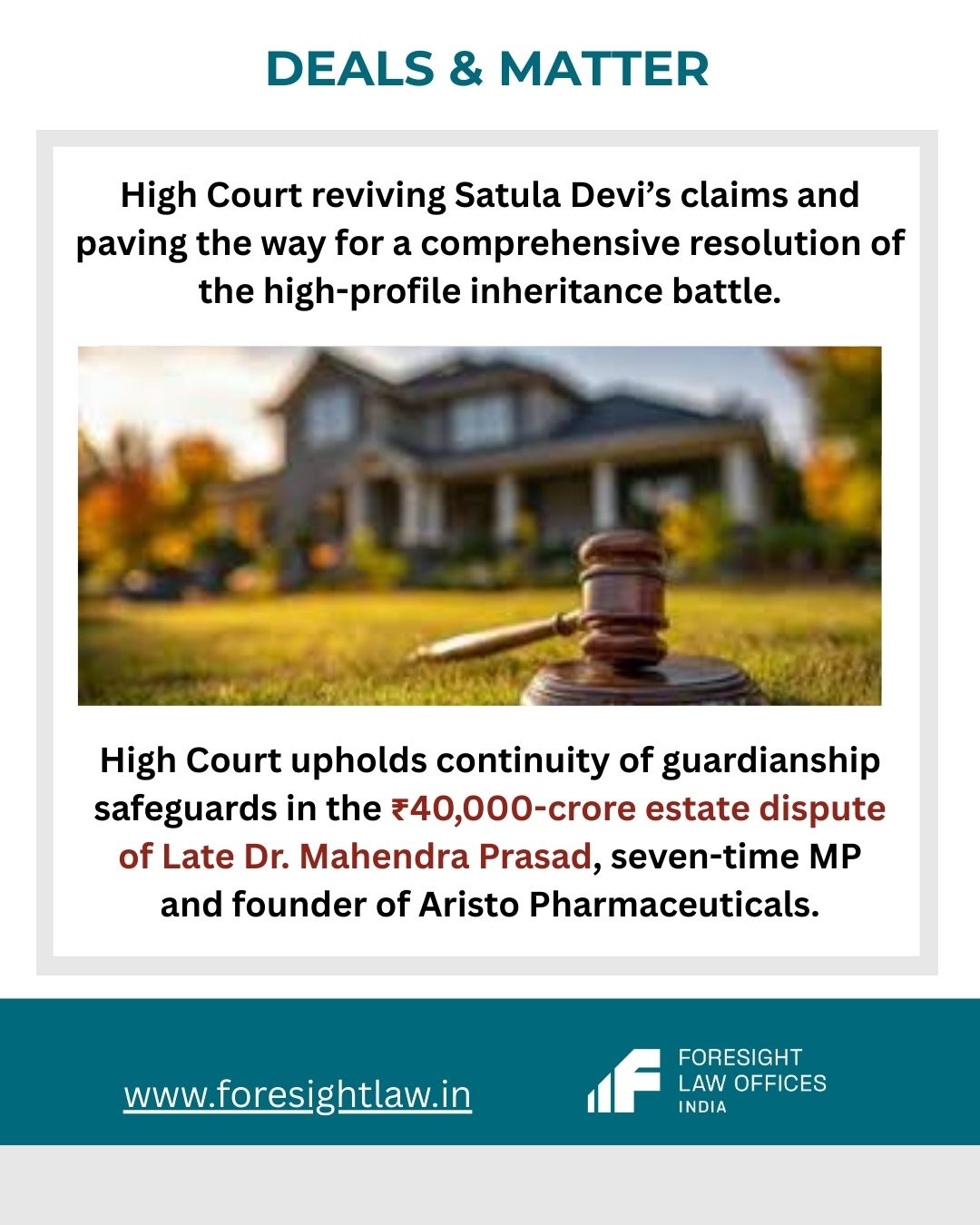
This judgment underscores the complexities of succession litigation when enormous estates, corporate holdings, and multiple claimants are involved. It balances regulatory oversight of incapacitated persons under parens patriae jurisdiction with the principles of succession law. Importantly, the Court prioritized asset protection, judicial restraint, and substantive adjudication of ownership claims, while leaving the ultimate question of testamentary validity to the probate court.
Through this decision, the Delhi High Court ensured continuity of guardianship safeguards, revived civil claims wrongly dismissed at the threshold, and paved the way for comprehensive resolution of one of India’s most high-profile inheritance disputes.